Showing posts with label Terrain. Show all posts

Thursday, February 27, 2020

15mm Roads

Last year I was looking at urban roads to add to my 15mm terrain for Flames of War. As nice as the Battlefield in a Box roads are, they're quite expensive, so I looked at making my own.

I had tried a variety of materials for roading in the past. The most successful was railway ballast glued to felt as gravel, but I was after a sealed look this time. EVA foam looked okay, but curls with age and is so light that it blows away in the slightest draught. MDF is rigid so doesn’t conform to terrain.

In the end I went with 1.5mm rubber sheet. This was $40/metre on a 1.2m wide roll from Para Rubber (https://pararubber.co.nz/industrial-rubber-strip/692-rubber-insertion-sheet.html).

I cut it into 3" wide strips, scuffed the surface with sandpaper (otherwise the glue beads up), brushed  on PVA, and covered it with budgie sand. Once the glue was dry and the excess brushed off, I sprayed it with flat black to help seal it. Using an art foam roller, I rolled on grey acrylic paint. It would have been quicker to spray them grey, but the hope was a heavier coat of acrylic would help give the surface some durability. The total cost worked out to be about NZ$1/foot.
The rubber scuffed up with sandpaper
Gluing down the sand
After being rolled with paint
The finished product
On the reverse side I am working through rolling on the grey paint without any sand, and adding centreline markings, for when I want a more modern look for Team Yankee.
Here are some photos of it in action in a game late last year.

Monday, December 11, 2017

Of Gauge and Scale

There was a recent question on the TY Facebook page asking about what railway track to use for terrain, and the discussion that followed has driven me to write this post on the topic.

The first key concept for railway miniatures is scale ratio, which relates to the size of the rolling stock relative to the full sized original.

The other concept is track gauge, which is the distance between the inner edges of the rails. Half of the world's railways, including those in France, Germany and Poland, have a gauge of 1435mm, which is known as Standard Gauge.

All model railway track, rolling stock and accessories are sold at a particular scale, which in this context refers to a specific combination of scale ratio, track gauge, and other factors that makes up the parameters of the system as a whole.

Scale
Scale Ratio
Track Gauge
Scale Error for Standard Gauge
O
1/46
32mm
+6.4mm at 1/56
S
1/64
22.5mm
-3.1mm at 1/56
OO
1/76
16.5mm
+2.2mm at 1/100
HO
1/87
16.5mm
+2.2mm at 1/100
TT
1/120
12mm
-2.4mm at 1/100
N
1/160
9mm
-5.4mm at 1/100
Z
1/220
6.5mm
+1.7mm at 1/300

For most scales, the scale ratio and the track gauge combine to create an accurate representation of a Standard Gauge railway. OO is a bit of an oddball where the track is underscale compared to the rolling stock for historical reasons. There are a multitude of other specialty scales, usually for narrow gauge prototypes. An example is NZ120, which is 1/120 on 9mm track, to represent New Zealand's railway network which has a gauge of 1067mm.

Obviously none of these are a perfect match for representing Standard Gauge in common wargaming scales. In 15mm you would require rolling stock with a scale ratio of 1/100 running on a track gauge of about 14.3mm, so it comes down to what compromises you are prepared to make: do you accept something too large, too small, do you go and scratchbuild your own, or do you simply avoid the problem?

I don't know why Battlefront chose to base their 'Battlefield In A Box' railway track on TT, but it seems to have led to an apparently widely-held but incorrect idea that TT is the perfect match for FOW. In reality, neither the track nor the rolling stock are any more accurate in 15mm than HO. As noted before, not all railways have the same gauge: in Russia the gauge is 1520mm, so for Eastern Front terrain the TT track is even more underscale than it is for the vast majority of rail lines in Northwest Europe.

From my perspective, what would be ideal would be a range of 1/100 rolling stock and accompanying 14.3mm track to use for 15mm wargames, with the next best thing being 1/100 rolling stock that sits on HO track, but alas as far as I can tell there is no such thing on the market. As such, wanting to have railway lines in my collection of TY terrain but being too lazy to scratchbuild, I have chosen to run with HO because of its price and availability, and am happy to accept that everything will be slightly too large.

Tuesday, September 12, 2017

New Project - TY Terrain

It's been a quiet winter hobby-wise, with very little to write about. I have, however, recently embarked on making a table of terrain for 15mm Team Yankee.

The parameters for the project are:
  1. Covering an 8x6 table, because to me that looks and feels better for TY above about 50 points.
  2. To be made from scatter terrain that can be packed down for ease of storage and transportation.
  3. Provide sufficient visual clues to be readily identifiable as modern Europe.
  4. Provide a range of logical locations for objectives.
That last two points are key for me. This might sound strange to people who play for the game, but I enjoy games that tell a story. The table plays a key role in this: helping place the events in time and space, and answering the question "what is so important about this particular piece of dirt?" An objective in the middle of a wheat field doesn't make sense to me, but a town, a crossroads, a hill: it's easy to imagine someone having a reason to want to seize or defend them. My aim when setting up a table is to have key points in the objective zones no matter which scenario is being played. That's actually easier on an 8x6 than a 6x4, because I believe the best way to play a lengthwise FOW or TY mission on an 8x6 is as a double width 6x4 rather than adding 2ft of almost entirely wasted depth, so you don't have to plan to be able to play down its length.

Here is the progress so far:
I still haven't decided on what season to set the table in, as that will determine the direction I take with trees and agriculture. I had been hoping for more of an olive green basecloth, but the material is darker than it appeared under the shop lighting. Life, and the never-ending search for the perfect basecloth.

Nor have I settled yet on the built up area. The buildings in the photo are from Plastcraft Games' ColorED range, of which I have two kits still to build. These buildings look nice and are reasonably economical, but the range is limited. The church of Sainte Mère Église is an impressive model, but it looks a bit out of place without three times as many smaller buildings clustered around it, so it may not make the final cut. I'm slightly hampered by the general lack of Streetview in Germany, but there is enough photography on the internet to draw inspiration from, and the look of the Plastcraft buildings seems to be reasonable. I do need a few more, and some more modern pieces to go with them. I also need to decide what I'll build around the small railyard in the bottom left.

The autobahn is made from 3mm EVA foam - at $17/metre from a 1.2m roll from Para Rubber it's cheaper and easier to work with than MDF. I'm currently planning an interchange with the local roads (the white pieces of paper in the bottom right), with those roads to be cut from the same material, and I'm looking at options for modern touches like guard rails and lighting.
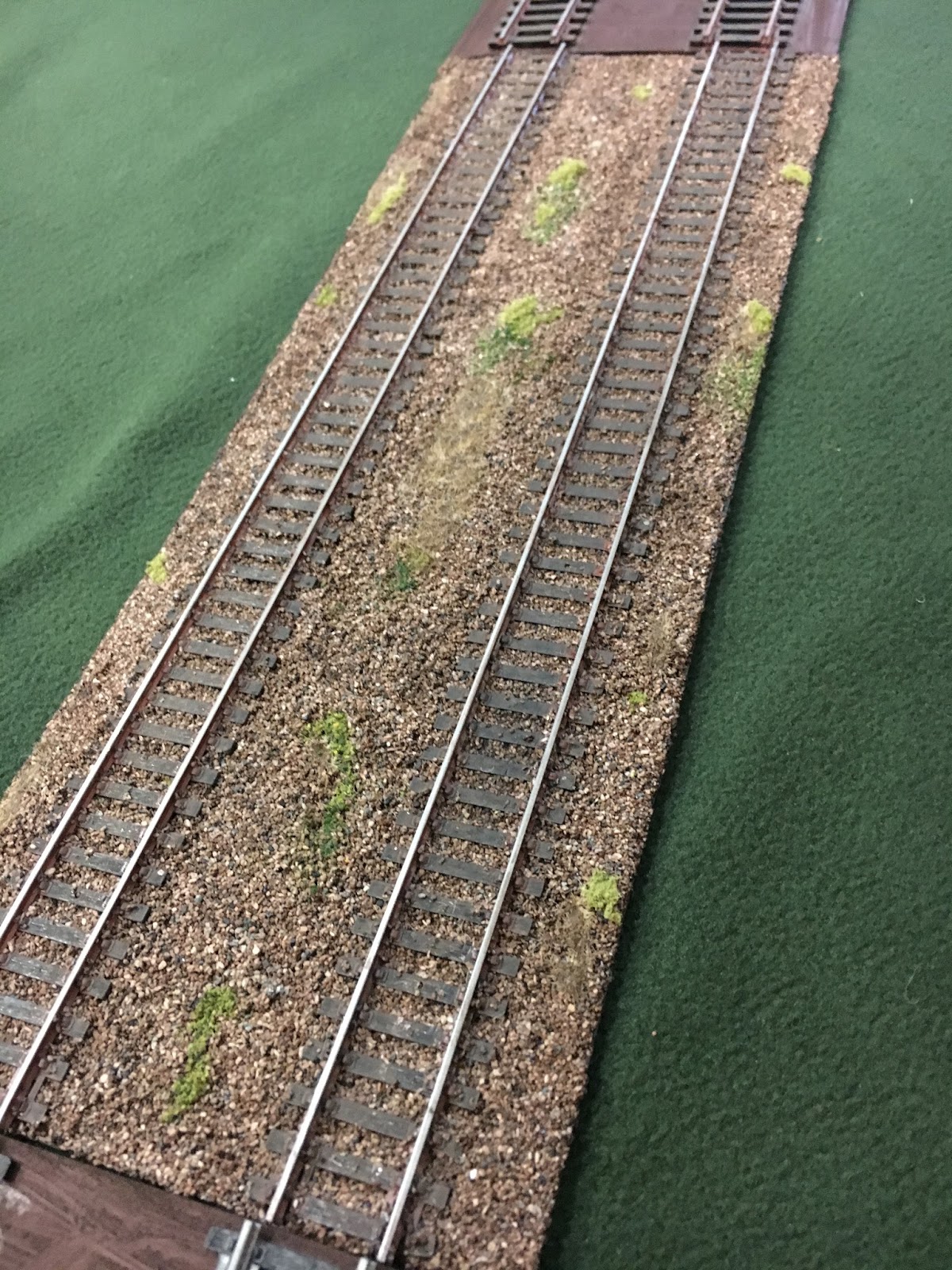
The railway line uses standard HO track, with the EVA as backing. With a gauge of 16.5mm, at 1/100 it is slightly overscale for the West German track gauge of 1435mm, however the commonly suggested alternative of TT scale at 12mm would be underscale by a similar amount. HO has the advantage of being cheap and readily available in NZ, whereas it looks like TT has to be bought in from Europe, so it was a simple decision that also opens up options for rolling stock and other accesories.
The plan from here is to finish off the rail sections, then move onto the interchange and the rest of the roading, and I'll post updates as progress is made.

Monday, January 18, 2016

Stream Sections

Just a quick update tonight.

The major feature missing from my concept for an Italian-themed table was a stream. I've been undecided about this for a while due to the impact of the obstacle on gameplay, but I've gone ahead as the table definitely needed something to break up the base colour.

The stream sections are based on MDF, with banks built up using polyfiller, and water made from multiple layers of PVA over the painted riverbed. Each section is about 40cm long and 10cm wide, with the feature as a whole broken into thirds by a bridge and a ford to provide crossings.


And here is the table as it currently looks:

Saturday, January 09, 2016

Terrain Project Update

I have completed the village for my Italy-themed table. The impression I wanted it to give was narrow streets, plastered walls, terracotta roofs, short lines of sight, and big enough that it could comfortably hold an infantry platoon plus support, and take effort to clear if players want to get involved in a street fight.

This had to be tempered by needing to use it in a game, with streets and buildings sized around the Flames of War base sizes, so the streets aren't as narrow and winding as they perhaps would be in reality, but I think it's captured the flavour I was after.


The village itself is 40cm by 40cm. Buildings were made from 2.2mm card, plastered to give texture, with roofs from HO-scale Spanish tile patterned styrene sheet. The roofs are removable to allow access into the buildings, and the buildings themselves are removable as well, located on pegs, so in theory I could put together another base in future and reuse the buildings in a different arrangement.


The smallest buildings hold two medium bases, with others holding three or four per floor.


Some alleyways are large enough for large bases, while others will only fit medium bases.


The current state of the table is this:


I have put some hills under the base cloth so the table is not quite so flat, but I still need to put together the bridge and the stream, and it probably needs some other bits and pieces just to break up the colour. Three weeks to go until the competition, and I'm back to work on Monday, so could be tight...


Sunday, October 11, 2015

Terrain Project

I've always been lacking in terrain, partly due to 10 years in the wilderness, during which time I never played, so this year I have decided to rectify that. I'm great at starting projects, but struggle to finish them off unless there's a specific purpose or deadline that I'm working to. So, with the terrain project I have set myself the goal of putting a complete 6x4 table's worth for ValleyCon.

The plan when I started was to do a Sicily-themed table. I then found out that the competition will be Early War, so that doesn't fit, and it doesn't even vaguely match the desert army I've decided to take. Such is life. I've decided to continue as I am, just so I can say I've finished a project. If I'm lucky I'll have time to do a desert table later.

The constraints I've placed on myself are as follows:
  1. Suitably sized for Flames of War's footprint. Just thinking about things like buildings that can comfortably fit a number of medium bases, area terrain big enough to hide an infantry platoon, roads which are wide enough for large bases, etc. 
  2. Transportation and storage. I love modular terrain boards, and there are some fantastic examples on the internet of them being done really well. Unfortunately, I'm a bit restricted in storage space and I don't think they're really an option for me, so the aim is to go for a traditional solution using a drop cloth and scatter terrain, that can be boxed up for storage, easily modified if it doesn't play as expected, rearranged to give some variety in future, and potentially extended to make an 8x6 table.
  3. Reasonably balanced for gameplay. This is tricky, as missions can be played across or along the table, by armies ranging from static to highly mobile. I want a good mix of bulletproof cover, some difficult going, sensible options for objective locations, and a few areas with decent lines of sight without the board being dominated by them.
  4. Cheap. There's a lot of wonderful terrain pieces commercially available, but they're expensive. I wanted to scratchbuild as much as possible to try and keep the cost down. 
Here's the basic road layout I'm starting with. The large black area on the right is going to be a town, with the smaller black area on the left potentially being a bridge. Not sure about that: a river makes sense for the setting, but can have a big impact on gameplay, so I may end up doing something else at that end instead.


The roads are made from railway ballast and coarse turf, glued onto a brown felt backing. I think it looks okay, it's flexible so can mould to contours, and is easily patched up when damaged. 


To try and get a Southern European feeling, I've added stone walls lining the roads, vineyards and olive groves.


I have no idea what Italian vineyards looked like 75 years ago, so mine are modelled on what I know: Marlborough. Sufficient space between rows for medium bases, and space in the headland for large bases. 


The olive trees are made from Woodland Scenic armatures. They're detachable to make storage and moving models through the groves easier. A couple of ideas tried here: one grove has the trees plugging into their bases as they're supplied, while the others use magnets. Not sure yet which way is better. 


I've tried to put lots of gates in so that the walls don't cripple vehicle movement too much. I don't think I have enough yet along the roads, so will build some more. Probably aiming for one gate every 18" of wall.


Still need to make buildings, and there are a number of things I need to decide: how to do hills, on top of the cloth or underneath it? What material to use for them? Do I make a bridge and put a river in? Luckily my eldest minion is pretty competent at FOW, so we can test a few ideas out in trial games and adapt the layout if it's not working.